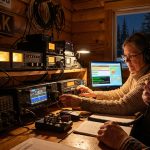

Operating amateur radio satellites from Alaska provides radio hams with a unique orbital advantage. Because many Low Earth Orbit (LEO) satellites move in polar or near-polar inclinations, operators in northern latitudes enjoy frequent overhead passes every single day, enabling reliable line-of-sight voice and data contacts across North America, Europe, and Asia.
Using handheld dual-band VHF/UHF transceivers connected to portable Arrow directional Yagi antennas, satellite enthusiasts manually track satellites like AO-91, SO-50, and the International Space Station crossband repeater. Operators adjust for Doppler frequency shifts as satellites travel across the horizon at speeds exceeding 17,000 miles per hour.
For remote Alaskan communities, satellite communications showcase how modest portable gear can achieve continent-wide contacts without relying on terrestrial infrastructure. High-altitude passes allow Alaskan hams to exchange grid square callsigns and participate in international satellite contests, proving that space communications remain accessible, educational, and deeply rewarding for amateur operators.
Did you enjoy this?
Log in to like this post.